

Raspberries
- The Home & Garden Store
- Dec 16, 2025
- 3 min read
General Information
Red raspberries are the most common type, while yellow raspberries are actually natural mutations of red varieties. Black raspberries produce blue-black fruit that is firmer and seedier than red or yellow berries, with a deeper, more intense flavor. Purple raspberries are crosses between red and black varieties.
Many gardeners place concrete rings or barriers around raspberry patches to help prevent spreading. Raspberries rarely grow under solid objects, but without containment they can spread rapidly across the soil.
Growing Requirements
Raspberries grow best in slightly acidic, well-drained soil. They prefer the Treasure Valley climates (cold winters), and a slow, gradual warm-up in spring (again. climates such as what we get in the Treasure Valley).
Mulching is highly beneficial: it moderates soil temperatures, conserves moisture, and helps control weeds.
Whenever possible, plant raspberry rows north–south to ensure all plants receive maximum sunlight without shading each other.
Fertilizing
For healthy, productive plants:
Apply ½ cup of Ferti-lome Azalea, Camellia & Gardenia Food in three monthly applications beginning mid- to late February.
Since raspberries thrive in slightly acidic soil, apply Ferti-lome Iron-Plus three times per year, starting in February, then June, and October.
Apply both fertilizers on the soil surface in a broad, even ring around each plant.
Planting Instructions
The best time to plant raspberries is during the dormant season, when bare-root plants are available and most economical.
Space plants 3 feet apart in rows.
Keep rows 6–8 feet apart.
Install posts 8 feet apart with heavy-gauge wire spaced 18 inches apart for support.
Cover wire with old garden hose if available as this prevents stems from being cut and helps reduce insect issues like raspberry cane borers.
Make sure any trellis system is strong enough to support the substantial weight of mature plants.
Fruit Production
Red and yellow raspberries produce fruit on upright canes.
Black and purple raspberries grow in clumps with arching canes.
Pruning
Red and yellow raspberries fruit twice:
First year: on the top third of the cane.
Second year: on the lower two-thirds.
Cut off the upper portion after the first season, then remove the entire cane after its second crop.
Summer-bearing varieties typically produce 3–5 new canes during their first year.
Raspberry Varieties
Raspberries grown in our region include both summer-bearing and fall-bearing types.
Everbearing (two-crop) varieties fruit in both summer and fall.
Summer-bearing (one-crop) varieties fruit once on second-year canes.
Fall-bearing types can be pruned entirely to the ground each winter if you prefer only a fall crop. Most varieties benefit from strong support, though some everbearing types need minimal staking.
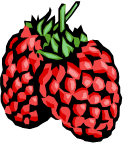
Red & Yellow Varieties
AMITY Everbearing. Large, dark red berries with excellent flavor. Tolerates heavier soils and is known for aphid resistance.
AUTUMN BLISS Everbearing. Medium to dark red berries with mild flavor. Harvest runs from late summer into early fall.
BOYNE Medium-sized berries that are tender, sweet, juicy, and aromatic. Great for jams, jellies, and freezing. Ripens early to midseason.
CANBY Summer-bearing. Bright red, large, thornless berries. Performs well throughout the Treasure Valley.
DINKUM Everbearing. Medium red fruit with good flavor. Excellent for fresh eating.
FALLGOLD Everbearing. Large, sweet, yellow berries with excellent flavor. Adapts well to local soils. Fruits from late summer to frost.
HERITAGE Everbearing. Large, sweet, dark red berries with slightly dry texture. Great for freezing, canning, jams, and fresh eating. Strong fall crop.
LATHAM Summer-bearing. Large, round, deep red berries with full flavor and great texture. Very vigorous and disease-resistant. Ripens late June to early July.
MEEKER Summer-bearing. Large, firm, bright red berries on long, graceful canes.
SUMMIT Everbearing. Large, flavorful red berries. Highly productive.
WILLAMETTE Summer-bearing. Large, firm, dark red berries that color and shape well.
Black & Purple Varieties
BRANDYWINE Large, purple berries with tart flavor. Ideal for jams and jellies. Late-season.
MUNGER Large, firm black raspberries with sweet flavor and low seediness. Excellent for preserves. Not the best for freezing. Mid-season.
ROYALTY PURPLE Everbearing. Large, firm, very sweet purple berries. Great for fresh eating, freezing, and preserves.
MORRISON Large, productive black berries. Late-season variety.



Comments